Most leadership debates sound like this: "I feel" versus "I think." Strong opinions. Light data. A lot of intuition and hope.
The economic way of thinking gives you something different. It gives you habits that turn messy conversations about risk, content, growth, or headcount into cleaner trade-offs. It does not require advanced models. It requires discipline about how you frame choices.
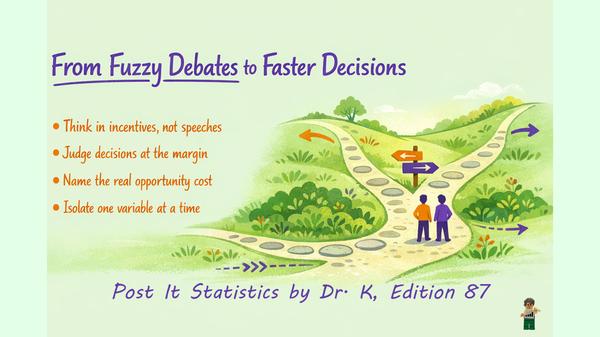
At its core, economics assumes people respond to incentives, not speeches. It asks you to judge decisions at the margin, not in total. It forces you to see the real cost of every choice, including the paths you quietly abandon. And it teaches you to isolate variables, so your team stops blaming or praising the wrong things.
For digital leaders, marketers, and data teams, these habits are not academic. They shape how you price, where you invest, how you treat talent, and which ideas you kill. When you think like an economist, you get less drama and more signal. You stop arguing about who is right, and start asking, "What happens if we change this one thing by one notch?"
Key Ideas:
Individuals are rational enough to respond predictably to incentives, so design systems that reward the behavior you actually want.
Marginal thinking turns "Is this good?" into "Is one more unit worth the extra cost right now?"
Opportunity cost makes invisible trade-offs visible, so every dollar and hour has a named alternative.
Ceteris paribus thinking helps you isolate one variable at a time instead of chasing neat but false single-cause stories.
Prices are information about scarcity and value, so ignoring price signals usually means misallocating scarce talent, capital, or attention.
Why it Matters
Leaders who use these habits reduce waste, avoid wishful spending, and move resources to higher return uses sooner. Over time, this compounds into better margins, stronger resilience in shocks, and products that track what customers truly value rather than what internal politics prefers.
Actionable Insights
Rewrite 1 current incentive: Pick a target behavior and adjust its reward or cost so that the rational choice aligns with your strategy.
Make 1 decision marginal: In your next resourcing debate, ask only, "Is one more unit of this worth its extra cost this quarter?"
Name the alternative: For any investment above a threshold, require a single written sentence: "The real cost is giving up X instead."
Run a ceteris paribus review: Take a recent result change and list all variables that moved, then test one change at a time where possible.
Listen to price signals: Choose one market where your prices or wages have not moved in years and ask what that is quietly telling you.
Marginal contribution per additional unit of effort in a key area, such as an extra campaign, extra feature, or extra shift is worth watching closely. It matters because it captures whether "doing more" is still creating enough extra value to justify extra cost. You can influence it by trimming low-yield increments, reallocating that effort to higher impact work, and testing smaller, reversible experiments before scaling.
Are you or someone you know an individual who argues well but rarely frames decisions in terms of incentives, margins, or trade-offs? Test whether one marginal, economic reframing could change a crucial decision this month.
To Conclude...
The economic way of thinking will not make your choices easy, but it will make them clearer and more honest. Once you start seeing incentives, margins, opportunity costs, and price signals, you cannot unsee them. The real tension is no longer between data and intuition, but between acting as if everything is a story and acting as if choices have structure. Where in your leadership this week could a single marginal question reveal what your decision is truly about?
Today's article is written based on a chapter from "Invisible Hand, Visible Profit: The Simple Science Behind Smart Decisions." This is an economics for businesspeople book that I have been writing for the last two years based on 30 years of economics, 25 years in the classroom, and 15 years advising businesses. It is almost done. Launching soon.