Have you ever purchased something big in your personal life that you were sure would change everything? You argued with everyone convincing them why it was a good thing to spend money on. And then, it just quite did not deliver on its promise or your expectations. What did you do with the item, then? Is it languishing somewhere in your house or garage or did you give it away? And how many times do you or someone around you bring up that failed "investment" when you are thinking of buying something new?
That emotional attachment of having spent not just the money but also your time on that past item continues to add more time and tentativeness in your present and future decisions. In economics, we would say you are allowing your sunk costs to still be considered for decision-making.
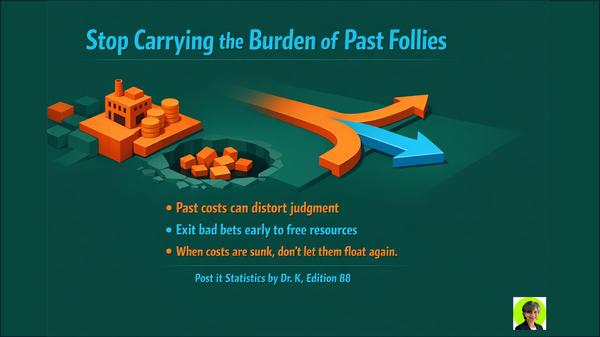
Sunk costs often lead to a fallacy because they can distort judgement and change the cost-benefit dynamic in a subjective manner. Forward-looking choices must shape value, risk, and growth and instead the adherence to the past prevents an objective view of the future.
Let us discuss some ways of overcoming this psychological difficulty of ignoring sunk costs with some rational economics-based thinking in this newsletter.
What Sunk Costs Mean for Business
A sunk cost is money already spent and never coming back. It may be a market study that produced no useful insight. It may be a software platform, an AI tool, or a facility lease that no longer fits the business. Once the cost is incurred, it is gone.
Yet leaders keep treating sunk costs as if they still matter. They do not change the economics of the next decision. They only change the feeling around it. A project can look “worth saving” simply because the team has already invested time, money, and status into it.
That is where judgment gets distorted. Continuing an unprofitable product, process, or platform can feel like discipline. In practice, it is often just resistance to naming a past mistake. The better question is simpler and harder: from here onward, what does this option cost, and what does it return?
The earlier a team separates the past from the future, the better it can reallocate real resources. That includes budget, attention, and management time.
Key Ideas
- Sunk costs are economically irrelevant to future choices. The only decision that matters is what the next move costs from here, and what it can return from here.
- Businesses often double down because stopping feels like admitting error. That emotional pressure is real, but it should not lead the decision.
- Past investment can make weak options look stronger than they are. This is especially dangerous in products, tools, and fixed assets.
- Exiting a bad bet early frees resources for better use. The trade-off is short-term discomfort versus long-term capital discipline.
Ignoring sunk costs improves decision quality and lowers risk. It helps leaders protect margin, avoid waste, and move resources into options with better upside. In plain terms, it keeps yesterday from taxing tomorrow.
Actionable Insights
- Separate past spend from future spend before reviewing any stalled initiative.
- Reframe the decision around the next dollar, not the last dollar.
- Write down what changes if the team stops now versus continues for one more cycle.
- Test whether current support is driven by expected return or by reluctance to admit loss.
- Compare each option only on its future costs, future risks, and future value.
Metric to Watch
Make a conscious choice to measure decision reversal time. The shorter the time between spotting a weak option and changing course, the less likely sunk costs are steering the business. Influence it by setting clear review points and forcing fresh evaluation at each one. If this pattern shows up in your organization, analyze where sunk costs most often distort judgment. What becomes easier once the past is no longer allowed to have a voice?
Closing Note
Leadership is not about defending every prior choice. It is about making cleaner choices now, with real information and less emotional drag. Stop funding history and start funding better judgment.
Today's newsletter is written based on a section of chapter 5 from "Invisible Hand, Visible Profit: The Simple Science Behind Smart Decisions." This is an economics for businesspeople book that I have been writing for the last two years based on 30 years of economics, 25 years in the classroom, and 15 years advising businesses. It is almost done. Launching soon.
Want to support my creations and business?
Please Subscribe and Share this Newsletter with your network!
- Follow Dr. Kruti Lehenbauer
- Share/repost my Newsletter with your network.
- Comment on topics that you enjoy reading about and share ideas that we can explore!
- Recommend me to SMBs & AI Startups seeking a Data Scientist or webapp designer.
DISCLAIMER: My Post it series only presents a snapshot of the possibilities that are out there. They are not designed to be comprehensive solutions. For folks who want to implement models or data analysis or improve their own businesses using any of these concepts, I am only a DM away! You can find #PostItStatistics on LinkedIn, Instagram, Facebook, X, and YouTube as well.