Money rarely moves on instinct alone. Behind the scenes, it is shaped by policy, structure, and timing. In the United States, that influence runs through the Federal Reserve, better known as the Fed. For many people, the Fed appears in headlines only when rates rise, markets shake, or inflation becomes the story of the month. But the real content of monetary policy goes much deeper than a single rate decision.
The Fed is the central bank of the United States, yet it is not simply an arm of the government. It is a hybrid system with public and private elements, built to make policy decisions that are meant to be objective and party-neutral. That design matters because every policy move carries real economic risk. It can affect borrowing costs, lending activity, inflation pressure, unemployment, and overall GDP.
Understanding the Fed is not just useful for economists. It matters for business owners, marketers, financial professionals, and anyone trying to read where the economy may be heading. When the Federal Open Market Committee, or FOMC, speaks, markets listen. When the Fed changes the supply of money or the cost of credit, the effects ripple outward through banks, businesses, and households.
This article breaks that process into plain English. We will look at who makes the decisions, which tools the Fed uses, how the money multiplier turns small actions into larger outcomes, and why policy effects often arrive much later than the headlines suggest. More importantly, we will connect those mechanics to business planning, so readers can turn policy awareness into real, fair, and practical decisions.
How the Federal Reserve Is Built to Influence the Economy
The Federal Reserve System is not a single office making isolated calls. It consists of a seven-member Board of Governors in Washington, D.C. and twelve Federal Reserve Districts located across the country, including New York, Chicago, Dallas, San Francisco, and St. Louis. This structure gives the Fed a national role with regional input, allowing policy discussions to reflect conditions from more than one local voice.
At the center of key monetary decisions is the Federal Open Market Committee. The FOMC has twelve members. These include the seven Board members, the President of the New York Federal Reserve Bank, and four of the remaining Reserve Bank Presidents on a rotating basis. Traditionally, the Chair of the Board of Governors also serves as Chair of the FOMC, while the New York Fed President serves as Vice Chair.
This matters because the FOMC is the group that shapes the cost and availability of money and credit in the economy. That is a powerful role. If money becomes cheaper and easier to access, economic activity can rise. If credit becomes more expensive and scarce, economic activity can slow. Those choices are never abstract. They affect hiring plans, borrowing strategies, consumer spending, and investment decisions.
The Board of Governors also holds regulatory and supervisory responsibilities over important parts of the banking system. That includes member banks, bank holding companies, some international banking facilities in the United States, and certain foreign banking activities. In other words, the Fed does not just guide policy. It also helps shape the broader environment in which financial institutions operate.
One useful point often gets lost in public debate. The Fed is separate from the government itself, even though top leadership is selected through public institutions. That separation is meant to lower the risk of purely political decision-making. Still, policy does not exist in a vacuum. Monetary policy operates within a wider economy shaped by fiscal pressure and non-monetary realities. That tension is part of the story, and businesses should keep it in view.
The Three Core Tools That Move Money and Credit
The Fed uses three main tools to either stimulate economic activity or slow it down. These tools may sound technical at first, but each one works through a clear chain of cause and effect.
The first tool is open market operations. This is the Fed buying or selling government securities, such as Treasury bills, with member banks. When the Fed buys securities, it pays banks with new money, adding liquidity to the banking system. When the Fed sells securities, it removes money from circulation. This is the most frequently used tool because it directly changes the money supply and has broad effects across the economy.
The second tool is the discount rate. This is the interest rate at which member banks can borrow from the Fed. Lowering the discount rate makes it cheaper for banks to access funds, which can support more lending throughout the economy. Raising the discount rate does the opposite. It makes liquidity more costly and can restrain borrowing and spending.
The third tool is the required reserve ratio. This is the percentage of deposits that banks must hold in reserve instead of lending out. If the ratio falls, banks can lend more of each deposit. If it rises, they must keep more money back. The context makes clear that this tool is not used as heavily in developed countries as it is in developing economies, but it still remains part of the Fed’s policy toolkit.
These tools support either expansionary or contractionary policy. Expansionary policy is designed to stimulate activity. Contractionary policy is designed to cool it. The Fed may also focus on intermediate variables, such as the federal funds rate or broader money measures like M1 and M2, as part of its wider strategy.
For businesses, the lesson is simple. Monetary policy is not just a background topic. It affects financing costs, customer demand, inventory decisions, and long-cycle investments. If your firm depends on credit, recurring consumer purchases, or sensitive cash flow timing, these tools deserve more attention than a headline scan.
Why the Money Multiplier Makes Small Fed Actions Much Bigger
One of the most important ideas in monetary policy is that money does not stop at the first transaction. It multiplies. That is why even a modest Fed action can lead to a much larger total change in the money supply.
The basic mechanism is straightforward. Imagine the Fed buys a $100 Treasury bill from a member bank. The bank now holds $100 in excess reserves. If the required reserve ratio is 20 percent, the bank must keep $20 and can lend out $80. That $80 will likely be deposited into another bank. The second bank keeps 20 percent, or $16, and lends out $64. That process continues through repeated rounds of deposits and lending.
In the example provided, the original $100 injection leads to a total money supply expansion of $500. The formula behind this is the money multiplier, which equals one divided by the required reserve ratio. With a reserve ratio of 20 percent, the multiplier is five.
This concept has major strategic value. A business that tracks monetary conditions can better anticipate downstream effects. If the Fed adds liquidity, the larger environment may eventually see easier credit conditions, stronger borrowing capacity, and more spending. If the Fed contracts liquidity, the reverse can unfold over time.
Still, theory and practice are not identical. The actual multiplier is usually smaller than its theoretical maximum. The context identifies two key leakages. First, borrowers may hold part of their funds as cash rather than redepositing everything. Second, banks may hold reserves above the required minimum. Both choices reduce the amount available for further lending.
This is where narrative intelligence matters. The numbers tell part of the story, but behavior tells the rest. In uncertain times, people and institutions often act more cautiously. That caution changes how far monetary policy reaches and how fast it moves. Businesses that understand both the formula and the human response can read the environment with more clarity and less sentiment.
Reading Fed Signals Before the Full Impact Arrives
Markets react quickly to Fed communication because expectations move ahead of outcomes. Speeches by Fed Board members and FOMC signals give businesses and investors a preview of what may be coming next. Even before policy is formally enacted, the environment can shift. Borrowing sentiment changes. Market pricing adjusts. Planning assumptions begin to move.
But there is a critical point that often gets overlooked. The effects of monetary policy take time. According to the context, the St. Louis Fed estimated that policy effects on GDP may take anywhere from three months to two years to become measurable. Effects on inflation often take between one and three years.
That delay creates a major planning challenge. The headline is immediate. The consequences are not.
This lag helps explain why public reactions can miss the bigger picture. A tightening decision may trigger instant commentary, yet the full pressure on business financing, customer demand, and supplier behavior may not show up for many months. Likewise, an expansionary move may not produce visible relief overnight. Monetary policy works through a chain of institutions, incentives, and responses. That takes time.
For business leaders, this creates both risk and opportunity. The risk is reacting emotionally to the current rate environment without understanding the cycle behind it. The opportunity is planning for the full path of impact instead of only the latest announcement.
A practical approach starts with three questions:
- First, how dependent is your business on borrowing costs?
- Second, how sensitive are your customers to changing credit and spending conditions?
- Third, how likely are your suppliers or partners to delay investment under tighter liquidity?
Those answers help translate Fed policy from abstract economics into real operating choices. A company that reads the mechanics and timing correctly is not guessing. It is building a fair response to the world as it is likely to unfold.
From Policy Theory to Business Strategy and ROI Decisions
The value of understanding the Fed is not academic. It is operational. Monetary policy shapes the environment in which firms budget, borrow, price, market, and grow. Even when the change starts in bank reserves or interbank rates, the effects can move into revenue planning and return on investment decisions.
Consider borrowing. If tightening is underway, the current financing cost may not reflect the full pressure still moving through the system. A business with variable-rate debt, expansion plans, or equipment financing needs should think beyond today’s number. Waiting too long can raise costs further. Acting too quickly without enough cash protection creates another kind of risk. Better planning sits between those extremes.
Customer behavior matters too. If tighter policy gradually reduces spending capacity, demand can soften later rather than sooner. That means marketing teams should not just ask whether sales are strong now. They should ask whether those sales are being supported by conditions that may weaken over the next several quarters.
Supplier behavior is another layer. A supplier facing higher borrowing costs may delay upgrades, hold less inventory, or pass costs forward. That affects your margins and delivery timelines. In this sense, Fed policy moves through the full chain, not just your own balance sheet.
There is also a voice lesson here for leadership teams. Internal communication should be calm, precise, and grounded in mechanics. Avoid hype. Avoid doom. Teams make better choices when they understand that policy effects unfold over time and rarely hit every area at once.
A firm that builds scenarios around monetary conditions gains more than awareness. It gains optionality. That may improve ROI by helping leaders protect margin, time investments better, and avoid reactionary moves. In a shifting economy, that kind of disciplined reading can be more valuable than speed alone.
Case Study / Real-World Example
Imagine a mid-sized business that relies on bank credit to finance inventory and seasonal expansion. The leadership team hears repeated signals from Fed speakers that tightening conditions may continue. Instead of focusing only on the current rate level, they review how policy may flow through the economy over the next year.
First, they assess direct borrowing exposure. Because some of their financing is sensitive to changing rates, they model what higher borrowing costs would do to margins if the tightening cycle continues. Next, they examine customer demand. A portion of their customer base depends on affordable credit and discretionary spending, so leadership assumes purchasing behavior could soften with a lag rather than immediately.
They also review supplier risk. If suppliers face tighter liquidity, inventory timing could become less reliable. To reduce that risk, the company adjusts reorder windows and updates cash planning. Marketing and sales teams are brought into the conversation, not to create alarm, but to align offers and expectations with a slower-moving demand environment.
Nothing dramatic happens overnight. That is the point. The business uses the execution lag to prepare before the full effect reaches operations. By the time tighter conditions become more visible in customer behavior and financing pressure, the company has already adjusted. It did not predict the future with certainty. It simply read the mechanics of monetary policy and acted with more discipline than emotion.
Key Takeaways
- The Federal Reserve influences GDP, unemployment, and inflation through monetary policy. Its decisions affect the cost and availability of money and credit, which then shape business conditions across the economy.
- The FOMC is the key decision-making body for monetary policy. It includes the Board of Governors and selected Reserve Bank Presidents, giving policy both central direction and regional input.
- The Fed uses three main tools: open market operations, the discount rate, and the required reserve ratio. Each tool changes liquidity in a different way, but all can alter lending, borrowing, and spending behavior.
- The money multiplier explains why small policy actions can lead to much larger changes in the money supply. Still, real-world leakages like cash holding and excess reserves reduce the theoretical maximum effect.
- Monetary policy works with a lag. Effects on GDP may take months or even years to show, and inflation responses often take even longer, which means fast reactions can miss the larger cycle.
- Businesses should translate policy signals into planning assumptions. Borrowing costs, customer demand, supplier behavior, and investment timing can all shift as Fed actions move through the system.
- Calm, structured decision-making lowers strategic risk. Firms that understand policy mechanics can make more fair and grounded choices than those that respond only to market noise.
Actionable Next Steps
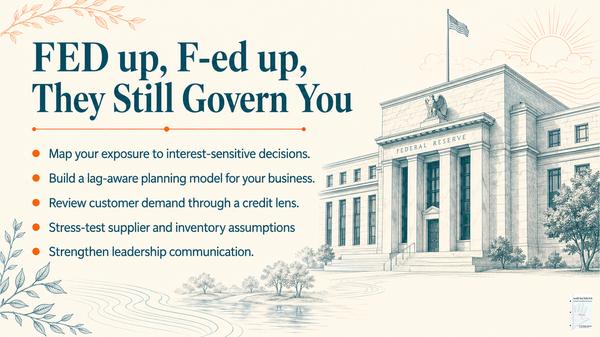
- Map your exposure to interest-sensitive decisions. Review debt, planned borrowing, and major investments so you know where Fed policy could raise cost or reduce flexibility.
- Build a lag-aware planning model. Instead of reacting only to current rates, create scenarios for how tighter or looser monetary conditions may affect your business over the next 12 to 24 months.
- Review customer demand through a credit lens. If your buyers depend on financing or discretionary income, adjust forecasts and messaging before the pressure becomes obvious in sales data.
- Stress-test supplier and inventory assumptions. Ask where tighter liquidity could slow production, reduce stock availability, or increase prices, then prepare backup options early.
- Strengthen leadership communication. Give teams a clear narrative about what the Fed is doing, why it matters, and how the business will respond with real discipline rather than emotional swings.
Conclusion
The Fed does not just set a tone for markets. It sets in motion forces that shape the wider economy over time. Through its structure, tools, and policy signals, it influences how much money is circulating, how expensive credit becomes, and how quickly economic activity expands or cools. Those changes matter to banks, but they also matter to every business trying to manage cost, demand, and growth.
What makes monetary policy especially challenging is the lag. The market often reacts now, while the economy adjusts later. That gap creates confusion for some and advantage for others. Businesses that understand the sequence can prepare earlier, communicate better, and make more balanced decisions.
The real call of the Fed is not just about rates. It is about timing, transmission, and scale. A small policy action can spread through lending and deposits far beyond its starting point. A single speech can shift expectations before any official move occurs. And a tightening or easing cycle can alter business conditions long after the headlines move on.
That is why the smartest response is not panic or passivity. It is informed preparation. Read the mechanics. Respect the lag. Turn policy signals into action before the effects become obvious. In a world shaped by money, voice matters, but disciplined interpretation matters more.
Implementation Guide
- Track FOMC communication consistently. Create a simple internal summary after major Fed updates so your team can connect policy language to business impact.
- Link monetary conditions to operating metrics. Review borrowing costs, sales sensitivity, and supplier reliability together rather than in separate silos.
- Use scenario planning instead of single-point forecasts. Build best-case, base-case, and tighter-liquidity views so leadership can respond with more confidence.
- Revisit reserve and cash assumptions regularly. Policy shifts can change financing conditions over time, so liquidity planning should stay active, not static.
- If you need a clearer framework for interpreting economic signals in your business content or strategy, contact me by email: contact@analyticstx.com for structured guidance.