
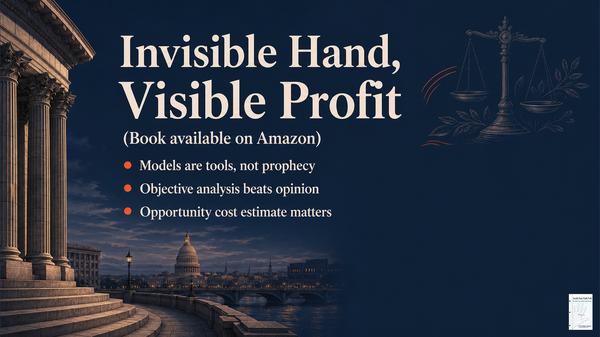
Most business leaders do not lose money because they ignore data. They lose money because they misunderstand what the data can actually say. That is the opening force behind Invisible Hand, Visible Profit: The Simple Science Behind Smart Decisions. Instead of beginning with abstract charts, the book starts closer to real life. It asks why people stay uninformed, how political language can hide weak reasoning, and why economic models should be treated as tools rather than prophecy.
Buy the book: Amazon Kindle Ebook, Amazon Paperback version.
Across ten chapters, the book turns economics into something practical. It shows how demand, supply, costs, competition, trade, and regulation shape everyday decisions inside firms. It also brings policy into the same frame. That matters because no business operates outside government influence, market structure, or resource limits. Pricing strategy, hiring, expansion, sourcing, and even product focus all sit inside an economic system.
What makes these chapters useful is their clarity. They separate positive analysis from normative opinion. They explain movement along a curve versus a shift in the curve. They distinguish accounting profit from economic profit. They show that market structure is not only about theory, but also about legal protection and regulation. Later chapters move into fiscal policy, the Fed, tariffs, and the book’s original Classification of Public Policy framework.
This blog walks through the book’s main ideas as a connected narrative rather than a list. The aim is simple: help readers see how each chapter builds a smarter decision process. If you understand what kind of problem you face, what your model includes, and where policy creates risk, you make more grounded choices with a steadier voice.
From Rational Ignorance to Useful Models
Chapter 1 resets the way economics is introduced. Rather than starting with graphs, it starts with rational ignorance. People stay ignorant about some issues because learning takes time, money, and attention. That choice is not always careless. It is often efficient. But in business, rational ignorance becomes dangerous when leaders rely on opinion where positive analysis is needed.
The chapter draws a sharp line between positive and normative analysis. Positive analysis deals with testable claims. Normative analysis expresses judgments about what should happen. Political discussion often sounds confident, but much of it is normative. If a leader treats those claims as reliable business guidance, the result can be costly.
This chapter also sets the narrative voice for the rest of the book. Economics is not about compliance with jargon. It is about asking better questions. Why did this happen? What mechanism produced it? What can I do with that insight? For managers and consultants, that mindset matters more than memorizing terms. It turns economics into a decision discipline rather than a classroom exercise.
Trade-Offs, Demand Shifts, and the Shape of Your Market
Chapters 2 and 3 move from mindset into market mechanics. The circular flow model shows where businesses sit in the wider economy. Households provide resources. Firms turn them into output. Money and real goods move in opposite directions. This is simple, but it gives context. Every business draws from scarce inputs and sells into a system shaped by consumer spending, production, and exchange. The Production Possibilities Curve adds the next layer. A logistics company running both freight and last-mile delivery cannot expand one service without affecting the other if resources remain fixed. More of one means less of another. Opportunity cost is not theoretical here. It is visible in staffing, equipment use, and managerial attention. Diminishing returns make the curve harder to ignore. Over time, the cost of pushing more output from one line rises.
Chapter 3 then sharpens the reader’s understanding of demand and supply. One of the most common business mistakes is confusing movement along a curve with a shift of the curve. If price changes and quantity demanded changes, that is movement along the curve. If quantity changes while price stays constant because market conditions changed, that is a shift. That distinction affects strategy. A movement may call for pricing adjustment. A shift may require broader repositioning, product changes, or new market analysis. If leaders misread a shift as a pricing issue, they can cut price when the real issue is changing consumer preference or stronger competition.
Elasticity deepens the practical value of the chapter. It tells you who absorbs a cost increase. If demand is inelastic, firms may pass higher costs to customers with less volume loss. If demand is elastic, passing costs through becomes risky. Businesses then face a harder choice between thinner margins and lost sales. Together, these chapters remind readers that market behavior is never random. It has structure.
Understanding that structure helps leaders make choices that are more precise, more fair to the evidence, and less driven by instinct alone.
Costs, Profit, and Why Competition Changes Everything
Chapters 5 and 6 translate economics into operational reality. The first important distinction is between accounting profit and economic profit. A company may show a positive return on paper while still destroying value compared with the owner’s next best alternative. That is opportunity cost at work. It is easy to ignore because it does not appear as a bill. But it is real. This matters for lending decisions, business continuation, and strategic expansion. A firm that looks healthy in the books may still be underperforming once forgone alternatives are counted. That changes how a manager reads success. Profit is not just money left after explicit costs. It is value above all relevant alternatives.
The chapter then moves into cost curves. Marginal cost drives production decisions. Average cost influences pricing strategy and scale. The pizza shop example makes the logic clear. Early workers add output efficiently. Later workers face a crowded kitchen and produce less additional output. Marginal cost rises. At some point, average total cost reaches its minimum. That point matters because it reflects the lowest unit cost available at current scale. This section has direct practical use. A business should know whether current prices sit above or below sustainable cost levels. It should also know whether growth improves cost efficiency or pushes the operation into congestion and rising unit costs.
Chapter 6 widens the frame to market structure. Perfect competition, monopolistic competition, oligopoly, and monopoly are not just labels. They define pricing power, margin pressure, and long-run strategy. The dairy example is especially revealing. It shows that market structure can be shaped by law, not just economics. Federally protected coordination changes what competition means in practice. That has strategic implications. Firms cannot study rivals alone. They must also study the legal and regulatory architecture around the market. A protected structure changes entry barriers, pricing behavior, and risk.
In other words, competition is never only about firms fighting for customers. It is also about the rules that permit or restrict how that fight occurs.
Externalities, Regulation, and the Long Run Response
Chapter 4 and Chapter 7 connect business conduct to public consequences. Externalities are costs or benefits imposed on people outside the transaction. When a steel mill pollutes water, the resulting harm falls on fisheries and municipalities, not just the mill itself. If those costs remain outside production decisions, the market outcome is distorted. This idea explains why regulation appears where it does. Banking rules target fraud. Environmental rules respond to unmanaged waste. Food and drug oversight responds to safety risk. Regulation is not presented here as a mystery or mere politics. It is often a response to unpriced harms that markets leave behind. For business leaders, this matters because regulatory pressure rarely comes out of nowhere. It emerges where negative externalities become too visible or too costly for others to absorb. A smart firm studies the harms it may be creating, even indirectly. That helps anticipate future rules rather than simply react to them.
Chapter 7 shifts the timeline. It argues that short-run policy intervention often creates long-run structural effects. Minimum wage increases offer the central example. When labor costs rise beyond productivity, firms automate. The fast-food kiosk becomes more than a technology trend. It becomes a long-run response to changed cost conditions. This chapter challenges the habit of treating policy as temporary and isolated. Governments may intervene in the short run, but those moves can stay in place and reshape incentives permanently. Businesses that focus only on immediate impact miss the larger adaptation path. The labor market changes. Production methods change. Employment patterns change.
The lesson is neither ideological nor abstract. It is practical. Decision-makers should ask not only what a policy does today, but what it pushes firms to become over time. That is where real strategic risk often lives.
Monetary Policy, Tariffs, and the Classification of Public Policy
The final cluster of chapters brings macroeconomics and policy analysis into the business toolkit. Chapter 8 focuses on the Fed and fiscal policy. When interest rates rise, capital becomes more expensive. That affects borrowing, expansion, and investment across markets. When government spending rises, firms may face stronger competition for the same labor and resources.The key caution is capacity. If the economy is already at productive limits, more demand does not create more real output. It creates inflation. That applies to both monetary and fiscal policy. Leaders who ignore this may overestimate growth potential and underestimate cost pressure.
Chapter 9 adds trade and tariffs. The book refuses to treat the global economy as a clean free market. Instead, it presents a world shaped by subsidies, state-owned enterprises, dumping, and strategic intervention. In that context, retaliation is framed not as betrayal of free trade, but as response to an already distorted system. The sugar tariff example shows distribution clearly. Domestic producers gain. Government collects revenue. Consumers and sugar-using businesses bear diffuse costs through higher prices. This is a powerful reminder that policy benefits and burdens rarely fall evenly. Some gains are concentrated. Some losses are spread thinly but widely.
Chapter 10 delivers one of the book’s most original tools: the Classification of Public Policy framework. Every policy is either microeconomic or macroeconomic. Minimum wage is presented as microeconomic because it targets a specific market, labor. Steel tariffs are macroeconomic because they affect the broader economy through government revenue, while still creating secondary effects in a particular market. Why does this matter? Because misclassification leads to poor strategy. If a business treats a targeted intervention as economy-wide, it may overreact. If it treats a broad policy as narrow, it may miss major exposure. The framework gives leaders a way to sort policy effects with more discipline and less panic.
Case Study / Real-World Example
Imagine a mid-sized food manufacturer that relies heavily on sugar and hourly labor. Management sees two policy changes arrive close together: a sugar tariff and a higher minimum wage. The first mistake would be to treat both as the same kind of shock. The book’s framework helps separate them.
The sugar tariff changes input cost directly. It raises the domestic price of sugar, which increases production expense. The firm must then evaluate elasticity. Can it pass the higher cost into final prices without losing too much volume? If customer demand is elastic, full pass-through may damage sales. That may force reformulation, packaging changes, or margin compression.
The minimum wage works differently. It primarily affects the labor market. For this firm, the immediate result is higher payroll cost. But the longer-run response may be process redesign. Management might consider equipment upgrades, scheduling changes, or automation in repetitive tasks. The issue is not only today’s payroll. It is how labor productivity compares with labor cost over time.
Now add competitive response. If rivals have lower sugar dependence or more automation, they may absorb pressure better. A simple cost model would not be enough. The company needs a fuller view of market structure, elasticity, opportunity cost, and policy classification. That is exactly the habit this book tries to build.
Key Takeaways
- Economics in this book starts with questions, not formulas. That shift matters because leaders make better decisions when they understand mechanisms rather than repeat terminology.
- Positive analysis and normative analysis are not the same. If you build strategy on opinion without testable support, you increase business risk.
- Demand and supply require careful reading. Confusing movement along a curve with a shift in the curve leads to the wrong response, often at the wrong time.
- Profit is deeper than accounting records suggest. Economic profit includes opportunity cost, which can change how you judge performance and growth.
- Competition depends on structure, and structure often depends on regulation. Markets are shaped not just by firms but also by legal protections and policy rules.
- Externalities explain why regulation appears. If your business pushes costs onto others, regulatory pressure is more likely to find you.
- Short-run policies can create long-run structural change. Firms that ignore delayed effects often miss the real direction of the market.
- Policy classification improves strategic response. Knowing whether a policy is microeconomic or macroeconomic helps leaders focus where impact is most real.
Conclusion
Invisible Hand, Visible Profit presents economics as a working language for better judgment. Its chapters move from the personal habit of rational ignorance to the larger systems of markets, competition, trade, and policy. The result is not a pile of theory. It is a structured way to think.
One of the book’s strongest contributions is its insistence on limits of economic models. Models help, but they do not see everything. Prices matter, but so do market shifts. Profit matters, but so does opportunity cost. Competition matters, but regulation can redefine the game. Policy matters, but only if you classify it correctly and understand where effects truly land.
That balance gives the book a practical voice. It does not ask readers to become economists in the academic sense. It asks them to become sharper observers of cause and consequence. That is more useful for most business decisions than mastering abstract language.
In a world shaped by uncertainty, inflation pressure, regulatory change, and strategic global distortion, simple thinking is not enough. But clear thinking still is. The chapters in this book offer a fair framework for turning complexity into better choices, one decision at a time. If your next move depends on what the market, the state, and your competitors do next, what are you still assuming instead of testing?