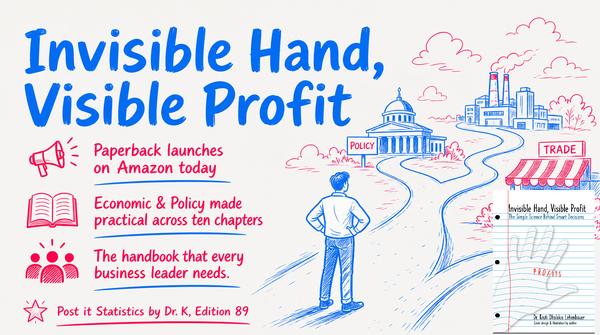
Across ten chapters, the book turns economics into something practical. It shows how demand, supply, costs, competition, trade, and regulation shape everyday decisions inside firms. It also brings policy into the same frame, because no business operates outside government influence, market structure, or resource limits. Pricing strategy, hiring, expansion, sourcing, and even product focus all sit inside an economic system.
The goal is simple: separate positive analysis from normative opinion and give decision makers a clearer way to think. The chapters explain movement along a curve versus a shift in the curve. They distinguish accounting profit from economic profit. They show that market structure is not only about theory, but also about legal protection and regulation. Later chapters move into fiscal policy, the Fed, tariffs, and my original Classification of Public Policy framework.
If you understand what kind of problem you face, what your model includes, and where policy creates risk, you make more grounded choices with a steadier voice.
A Practical Example
Imagine a mid-sized food manufacturer that relies heavily on sugar and hourly labor. Two policy changes arrive close together: a sugar tariff and a higher minimum wage. The first mistake would be to treat both as the same kind of shock. The book’s framework separates them.
- Sugar tariff: raises input cost directly; affects pricing strategy, elasticity, reformulation, margins.
- Minimum wage: changes labor cost; affects process design, automation decisions, productivity tradeoffs.
- Competitive response: determines whether rivals absorb pressure better.
A simple cost model is not enough. The company needs a fuller view of market structure, elasticity, opportunity cost, and policy classification. That is the habit this book builds.
Chapter Breakdown
- Why Economics Hits Close to Home establishes the economic way of thinking and challenges basic assumptions we operate under in business and the economic reality we live in.
- We Are All Just Circling Around describes the architecture of economic systems through the circular flow, laying out how households, businesses, government, and nations interact using resources and products.
- What Lies Beyond Demand and Supply presents demand and supply in the context of business decision making and market responsiveness, with focus on what actually drives strategic business decisions.
- Where Market Failures Stem From covers causes and corrections of market failures, with focus on regulatory environments and why regulation appears where it does.
- Who Pays for Your Choices discusses cost and revenue frameworks that separate accounting from economic reality and explains how businesses choose how much to produce based on these relationships.
- Why Care About Your Competition discusses types of competition to help readers self-identify where their business falls and what that implies for pricing power, margins, and long-run survival.
- In The Long Run, We Are Not All Dead compares and contrasts long-run (classical) and short-run (Keynesian) theories of economic growth, inflation, and employment, showing how short-run interventions create long-run structural effects that policy makers don't really consider but business owners should.
- Fed Up, F-ed Up, They Still Govern describes the reasoning and nuances of monetary and fiscal policies with targeted analysis of their impact on business decisions, and why there is a repeated disconnect between the two in the real world.
- A Saga of Trade and Tariffs presents a stark comparison between models of free trade and realities of the true global market using the lens of tariffs.
- Which Policy Makes You Panic? introduces my original Classification of Public Policy model that brings clarity to decision makers on identifying precisely what aspect of their business is likely to be affected by which government policy and how.
If you want to read more about each chapter: Visit my Blog
Actionable Next Steps for Readers
- Audit your decision models for missing variables
- Review pricing logic through elasticity
- Recalculate profit using opportunity cost
- Map regulatory exposure
- Separate policy shocks by type
- Examine long-run substitution options
Conclusion
Invisible Hand, Visible Profit presents economics as a working language for better judgment. The chapters move from rational ignorance to markets, competition, trade, and policy, building a structured way to think rather than a pile of theory. It does not ask readers to become economists. It asks them to become sharper observers of cause and consequence, a far more useful skill for business decisions.
If your next move depends on what the market, the state, and your competitors do next, what are you still assuming instead of testing?