What happens when a policy meant to protect people blocks the very signals a market uses to respond? That question sits at the center of debates about price controls. Price ceilings and price floors often sound fair in public discussion because they promise relief, stability, or support. But markets respond to incentives, scarcity, and available information whether or not policymakers account for them.
The tragedy of price control policies lies in the fact that most people focus on the intention and often skip the market mechanics. A ceiling can cap what a seller charges. A floor can set the minimum a buyer must pay. In both cases, government overrides the price that would otherwise help buyers and sellers adjust to changing conditions. The result can be a deeper shortage, weaker investment, a stubborn surplus, or added waste.
Let us discuss how price controls work, why public sympathy can blur who is buying and selling, and how policies designed to improve fairness can exacerbate or introduce new market failures instead.
Price Ceilings and Market Signals
A price ceiling sets a maximum legal price for a good or resource.
- Sellers cannot charge above the cap.
- Buyers see a lower price than scarcity would otherwise signal.
- The market loses a key adjustment tool.
In practice, this matters because price helps ration limited goods. When demand rises quickly, higher prices push buyers to narrow purchases to what they truly need. At the same time, those higher prices reward sellers for the added costs of restocking.
Let us consider an example. Demand for gas spikes before a major storm, when supply is already tight. In an unrestricted market, sellers would want to charge more for gas. At higher prices, people would have less incentive to buy more gas than they need, while sellers would have greater incentive to pay more to replenish their stocks ahead of time. This can prevent or limit the problem of gas simply not being available anywhere.
Once a price ceiling is imposed, both buyers and sellers lose the incentives to ration. Early buyers will fill up more gas than they may need. Later buyers arrive to find less gas available, or even find stations sold out. The lines for gas lengthen. What should have been a temporary shortfall can turn into a deeper shortage because the low price blocks rationing and discourages suppliers from trying to restock at higher costs.
Consider what rent controls mean for housing markets with an objective lens: Who is the policy actually helping, and how? Which other examples of price ceilings can you think of?
Price Floors Disrupt Equilibrium
A price floor sets a minimum legal price.
- Buyers must pay at least that amount.
- Producers face protection from lower market prices.
- Output can stay high even when demand falls.
If the price of a product or resource is low, there are often limited producers in the market to begin with. On the other hand, buyers make decisions based on how much of the product or resource they need, and the market stabilizes at a low price point with no shortage or surplus. Most producers will try to differentiate themselves if they want to capture higher prices in the market, which results in greater innovation in the market itself. The market develops over time due to these innovations.
A price floor can offset this "low price" situation by artificially increasing the minimum price above market equilibrium. The quantity supplied becomes greater than the quantity demanded, resulting in persistent surpluses and reduced incentives for differentiation among producers.
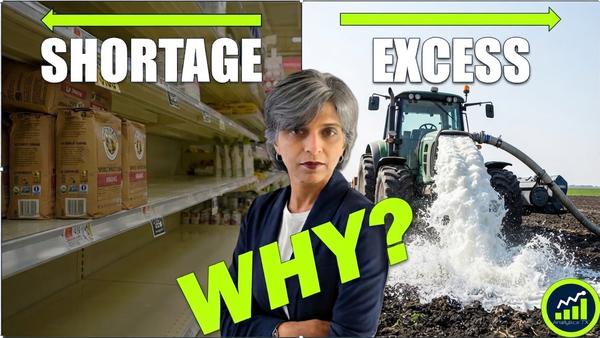
Let us consider agricultural product markets, where government sets price floors to ensure that farmers keep producing sufficient food even when market prices are very low. In many instances, the government purchases the surplus to ensure producers do not cut output. Buyers did not buy, producers did not produce less, and the surplus is often dumped or otherwise disposed of.
Economic disincentives caused by price floors explain why massive food waste and food insecurity can coexist in many economies. Ironically, the paperwork burdens of government purchasing surpluses hit smaller farms the hardest. Many of them eventually sell to larger corporate farms, which means intended protection removed the very producers it aimed to help.
Consider another common market in which price floors are seen: the labor market. A minimum wage is essentially a price floor on wages. Given the political intensity of this topic, it is best for the reader to objectively analyze for themselves what market distortions are introduced into the labor market by minimum wages.
Why Buyer and Seller Roles Matter in Perceptions
Public debate often gets confused because the business side does not play the same role in every market.
- In housing, business is often the seller.
- In labor, business is often the buyer.
- That shift affects how people judge motives and outcomes.
It is only human to prioritize the impact of pricing on people versus the impact on businesses. However, it is critical to remember that households and businesses are the primary actors in the circular flow of the economy. A negative effect on either one eventually circles back to the other, regardless of the perceptions surrounding it.
Price control policies most often focus on the human impact because that's where most public support comes from. It becomes harder to keep the attention on market mechanics instead of moral framing. And this is why market failures persist without a clear end in sight, while policies often become even more restrictive over time.
How to Evaluate Price Controls More Carefully
You can use these steps to read policy debates with clearer economic logic:
- Identify the market roles: Ask who is buying and who is selling and who is being incentivized to do what with price signals. Is public sympathy tipping the scales in the debate?
- Check the direction of the control: A ceiling pushes price down; a floor pushes price up. Each creates a different distortion. Who is impacted when there is a shortage or surplus?
- Look for blocked signals: Ask how buyers and sellers respond to persistent shortages or surpluses in the market. What is being ignored and what is being wasted?
- Trace long-run effects: Consider investment, quality, compliance costs, and producer mobility in the market. Which sellers are leaving the very market that was changed to support them?
- Compare real overall costs: The key test is whether the intervention reduces total costs to the economy or builds unseen costs such as time or destruction of outputs. Who is bearing these costs?
The Real Test Is Market Signals
Price controls can feel persuasive because they speak the language of fairness. But markets respond to incentives, not moral language alone. Ceilings can deepen shortages. Floors can sustain surplus and waste. Over time, both can reshape supply, quality, and who remains in the market.
Market failures are not imaginary or false but policy interventions may not always be the optimal solution for them. Any intervention must be judged by its results, including the new costs it creates in public and private life.