
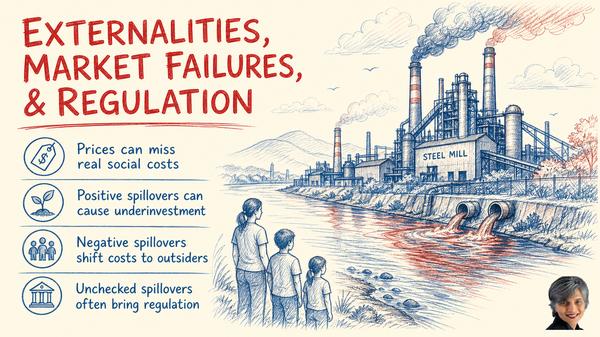
A market can look orderly and still produce the wrong result. Buyers pay, sellers supply, and prices seem to coordinate everything well. Yet some real costs never show up on the invoice, and some real benefits spread far beyond the original transaction. Those gaps are where market failures begin.
In this context, market failure does not mean collapse of the market. It means the price mechanism leads to an inefficient outcome. Too much may be produced, too little may be invested, or something valuable may be left underprovided because private actors cannot capture enough return.
There are four situations that contribute to market failures: externalities, essential goods with no viable private market, information asymmetry, and price controls. In this blog, we will focus on externalities contributing to market failures.
Externalities show how a private decision can shift costs or benefits onto others who were never part of the exchange. Let’s walk through how that happens and why it matters for business, regulation, and long-term trust.
How Market Failure Disrupts Equilibrium
Markets usually aim toward equilibrium through prices. But equilibrium becomes an illusion when prices leave out important effects.
- Externalities distort private choices because decision-makers focus on their own costs and benefits.
- Essential goods may lack a workable private market.
- Information may stay unevenly shared between buyers and sellers.
- Price controls can override what the market would otherwise settle on.
The result is systematic inefficiency. The number the market reaches is not the same as the socially efficient outcome.
Positive Externalities and Underinvestment
Positive externalities happen when benefits reach people beyond the buyer and seller. The social value is larger than the private return.
A business that provides training to their workers gives them skills that remain valuable even when those workers move to another job. Other employers benefit from a stronger labor pool without paying the training cost. Basic research works similarly because its value can spread across industries and over time.
When firms cannot capture the full benefit they create, they invest less than the true equilibrium would justify. Still, these efforts can build trust, goodwill, and brand value over time.
Negative Externalities and Hidden Social Costs
Negative externalities appear when private production leaves costs for others to absorb. Those costs stay outside the firm’s accounting, even though society still pays them.
Consider a steel mill that decides to dump their waste materials in the nearby river:
- Pollutants enter the water and water treatment costs rise.
- Nearby communities bear health costs.
Because the market price reflects private cost rather than social cost, output rises above the socially efficient level. These harms are often difficult to quantify, which makes them easier for firms to ignore and harder for affected groups to justify.
Why Regulation Follows Unchecked Spillovers
When markets do not correct serious spillovers, regulation often follows. Environmental rules, banking oversight, and food or drug regulation are presented here as common responses to fraud, pollution, unsafe practices, or similar damage.
That response brings its own effects:
- Compliance adds business costs.
- Supply may tighten.
- Entry barriers often rise.
This helps explain why regulated industries often grow more slowly. It also explains why some firms try to internalize costs before rules force the issue.
A Walkthrough of Externalities in Business Decisions
There is a practical sequence that many businesses face. A company creates a spillover, then the wider system reacts.
Start with the steel mill. It produces output and prices based on private production cost. Pollution discharged into the river never appears on the firm’s cost sheet. Yet nearby communities face health effects, and water treatment becomes more expensive. Society carries the difference.
Over time, those external costs become harder to ignore. Public pressure or visible harm opens the door to regulation. Once rules arrive, the company faces compliance costs that can raise prices and restrict supply. The same pattern appears more broadly in regulated industries.
Now compare that with a business creating positive spillovers. Workforce training improves employee skills, but the benefits also spread to future employers. Basic research can create value well beyond the firm funding it. Because the company cannot capture all of that value directly, it may invest less than society would prefer. Even so, these actions can build goodwill, trust, and long-term brand strength.
Where Businesses Often Misread the Real Cost
The hardest part is that spillovers rarely feel immediate inside the firm. Short-term margins are visible. Social effects are often diffused.
Ask a few basic questions:
- Which costs are being absorbed by outsiders rather than the business?
- Which benefits are spreading beyond paying customers?
- Are today’s pricing decisions creating tomorrow’s compliance burden?
Negative externalities are especially easy to miss because they are hard to measure and justify in exact terms. Positive externalities create a different issue. A firm may underinvest because the return arrives indirectly through trust, reputation, or a stronger community rather than direct payment.
There solution is to map where your externalities land. That makes it easier to anticipate regulatory pressure, reputational risk, and strategic openings before they become expensive surprises.
Steps Businesses Can Take to Map Externalities
- List direct market choices: Start with the transactions your business controls. Identify what buyers and sellers see clearly in price and contract terms.
- Trace outside effects: Map who bears costs or receives benefits beyond the transaction. Look for pollution, noise, wear-and-tear, training spillovers, research gains, or other social effects.
- Compare private and social returns: Ask where private cost differs from social cost, or where private return falls short of social benefit. This reveals where output or investment may be off balance.
- Anticipate regulatory pressure: Unchecked social costs often invite rules. Use that pattern to prepare for compliance burdens, supply shifts, or higher entry barriers.
- Internalize where possible: Absorbing real costs early may narrow margins at first, but it can strengthen trust, brand loyalty, and long-term support.
Looking Beyond the Price Tag
The central lesson is simple: prices do not always tell the full story. Some costs land on outsiders, some benefits spread without payment, and both can pull the market away from a socially efficient outcome.
For businesses, this is more than theory. Externalities shape regulation, compliance costs, reputation, and strategic resilience over time. Firms that understand their externality profile early are better prepared for what follows in the market and beyond it. When a price looks efficient on the surface, what hidden costs or hidden benefits might still be waiting underneath?
---
This blog was written using Ryza Content Creator.
If you like learning about economics in an easy to apply manner, don't forget to get your copy of "Invisible Hand, Visible Profit: The Simple Science Behind Smart Decisions" as an eBook, Paperback, or Audiobook on Amazon, Apple Books, Google Play, Spotify, and other platforms.